Spec Trumps Mileage. The market has rewritten the rules
For years, low miles commanded a premium above all else. Over the last year, the collector car market has shifted — dramatically. Today, the right color combination and factory specification can outprice a lower-mileage example in a standard configuration by six figures.
In twelve years of operating at the top of the vintage Ferrari market, we have watched one axiom hold firm through every cycle: miles matter most. Buyers paid premiums for low-odometer examples without asking many other questions. That era has shifted. What we witnessed across the auction block from late 2025 into 2026 represents a structural repricing — one driven by the scarcity of rare-spec cars and a new generation of collectors who want what they want and if they were to order a new one, it most likely wouldn't be plain Red on a Ferrari or plain Silver on a Porsche.
Why color and spec now command a premium
The answer is elegantly simple: we cannot go back to the factory. No one is building new 355s. No one is pressing new Testarossas. The global supply of a 512 TR finished in Nero Daytona over Rosso leather is fixed — permanently — at whatever number rolled off the Maranello line three decades ago. That absolute scarcity is the engine behind this repricing.
What has changed is who is buying. The new cohort of collectors entering the space — younger, increasingly curious. They want rarity within rarity. And they are willing to pay for it. They want rare and interesting spec’d examples
A high-mile car in a rare color combination, with correct documentation, will consistently outperform a low-mile car in a standard configuration. The market has confirmed this repeatedly, across marques and price tiers."
Spec premium vs. low-mileage discount — recent transactions

Ferrari 512 TR — Nero Daytona rewrites the ceiling
The 512 TR is a car we know well. We have transacted in multiple examples and have a firm handle on where the market clears. When a 1992 example surfaced in the Mecum staging lane — Nero Daytona over Rosso leather, 22,693 miles — we inspected it from top to bottom and spoke with two specialists that we do a lot of trading with we ran the numbers — we were nowhere close.
The consensus: this car retails for $550,000–$575,000. The miles were the one check against it. The color combination, paperwork, condition, and presentation were all exceptional — the car presented as though it had 3,000 miles on the clock. We were prepared to bid accordingly.
We were dismissed entirely. The gavel came down at a price inclusive of fees that neither we nor our associates anticipated: $715,000. That is not a rounding error. That is a $140,000–$165,000 premium paid specifically for color and specification — on a car with over 22,000 miles.
Ferrari 512 TR — Transaction Comparison
The 1994 is objectively rarer — only 27 U.S.-market examples were produced that model year. Lower miles. Statistically scarcer by year. Yet the 1992 in Nero Daytona outperformed it by $165,000. The color premium was real, quantifiable, and substantial.
Ferrari 550 Maranello — the Blue Nart premium emerges
The 550 Maranello data set is particularly instructive because we have multiple recent data points across a compressed time window. The pattern is consistent and increasingly difficult to dismiss as auction variance.
Blue Nart — an evocative, period-correct color with deep ties to Ferrari's North American Racing Team history — is establishing itself as the specification to own. The market is paying a meaningful premium for it, even when the miles are not in the car's favor.
Ferrari 550 Maranello — Transaction Log
Porsche 997 GT3 RS 4.0 — the same dynamic, validated across marques
This is not a Ferrari phenomenon. The Porsche 997 GT3 RS 4.0 provides a clean, well-documented illustration of the spec premium operating at scale. With approximately 600 examples produced, the color distribution makes the analysis straightforward.
Ferrari F430 Scuderia — black commands a 50% premium over a 673-mile red
The F430 Scuderia data set delivers perhaps the most striking single comparison in this analysis. A black-over-black example with 16,000 miles outperformed a red car with 673 miles — by $219,000. That is not a modest premium. That is a category-level repricing.
Ferrari Enzo — non-red commands the market, and we know it better than anyone
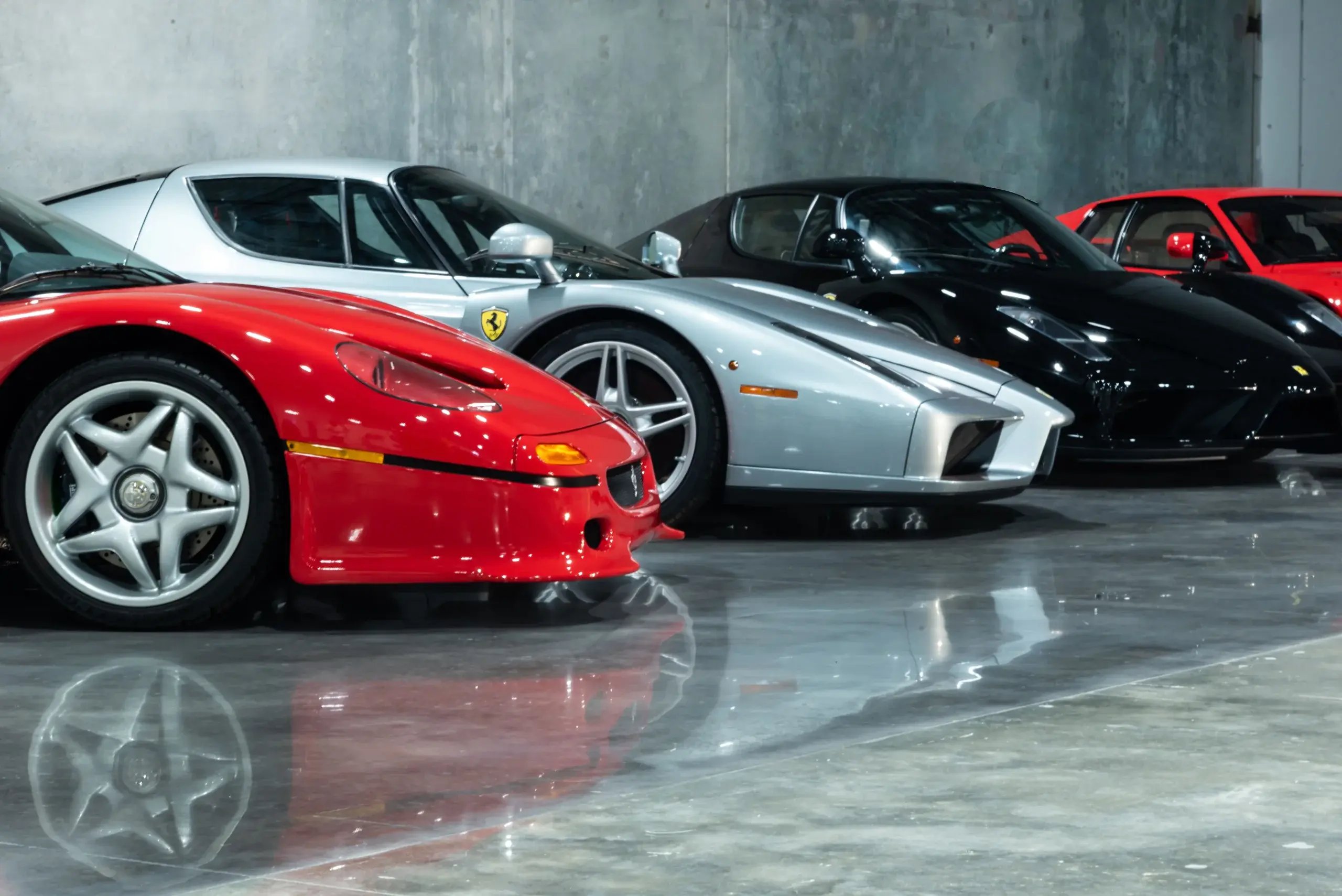
The Enzo is where the color premium thesis reaches its most dramatic expression. Approximately 400 examples were produced, and the overwhelming majority left the factory in Rosso Corsa. That makes anything outside of red a genuine rarity — and the auction results from the last six months confirm the market understands this completely.
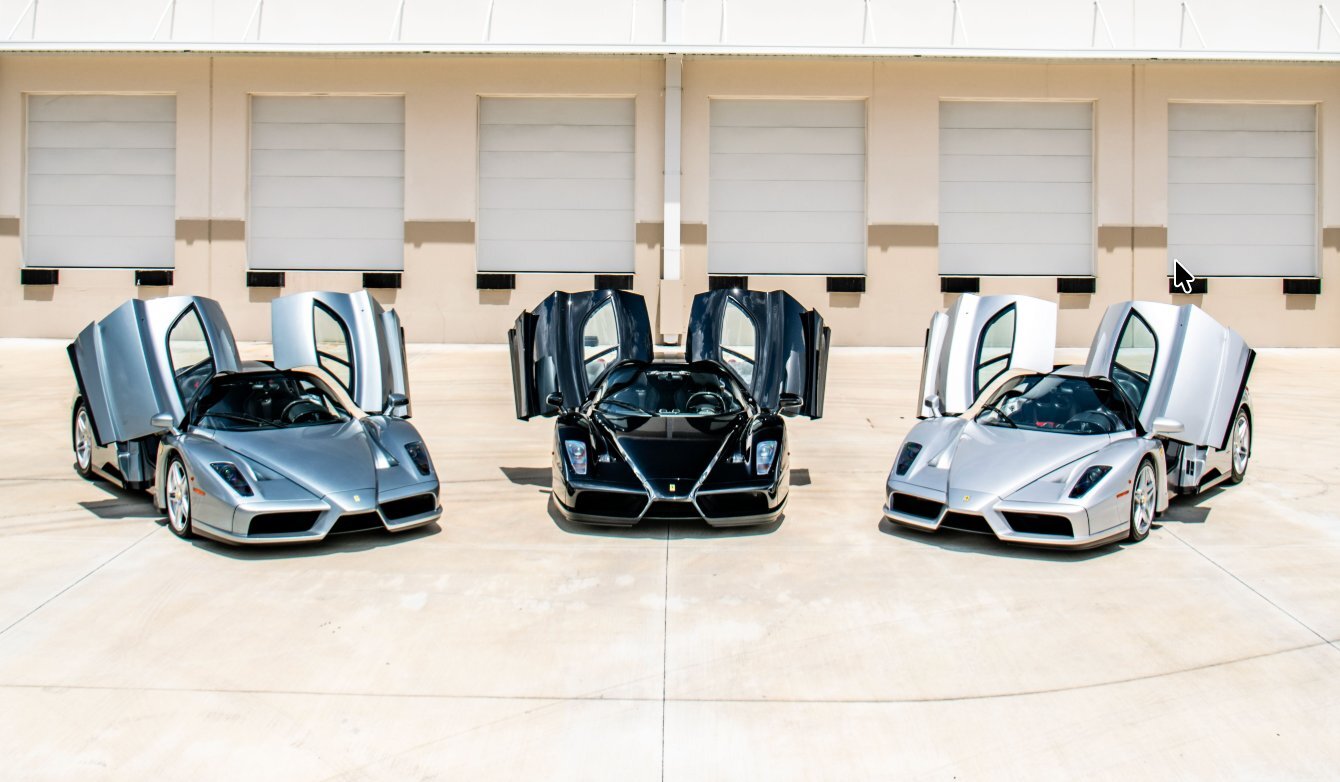
We have been buying non-red Enzos since 2024. Our thesis was straightforward: the color premium is real, the scarcity is structural, and the market had not yet fully priced it in. We were the only dealership to own three non-red Enzos simultaneously. Our inventory included a mix of Euro and U.S.-spec examples, and we found that U.S. versus Euro was a far less determining factor than color. Non-red has consistently and substantially outperformed red across every transaction we have observed and participated in.
The same dynamic has now appeared in the 599 GTO. We transacted in several examples last year — none of them red — and each brought approximately 25–30% more than comparable red examples. The pattern is consistent and accelerating.
Ferrari Enzo — 2026 Transaction Log